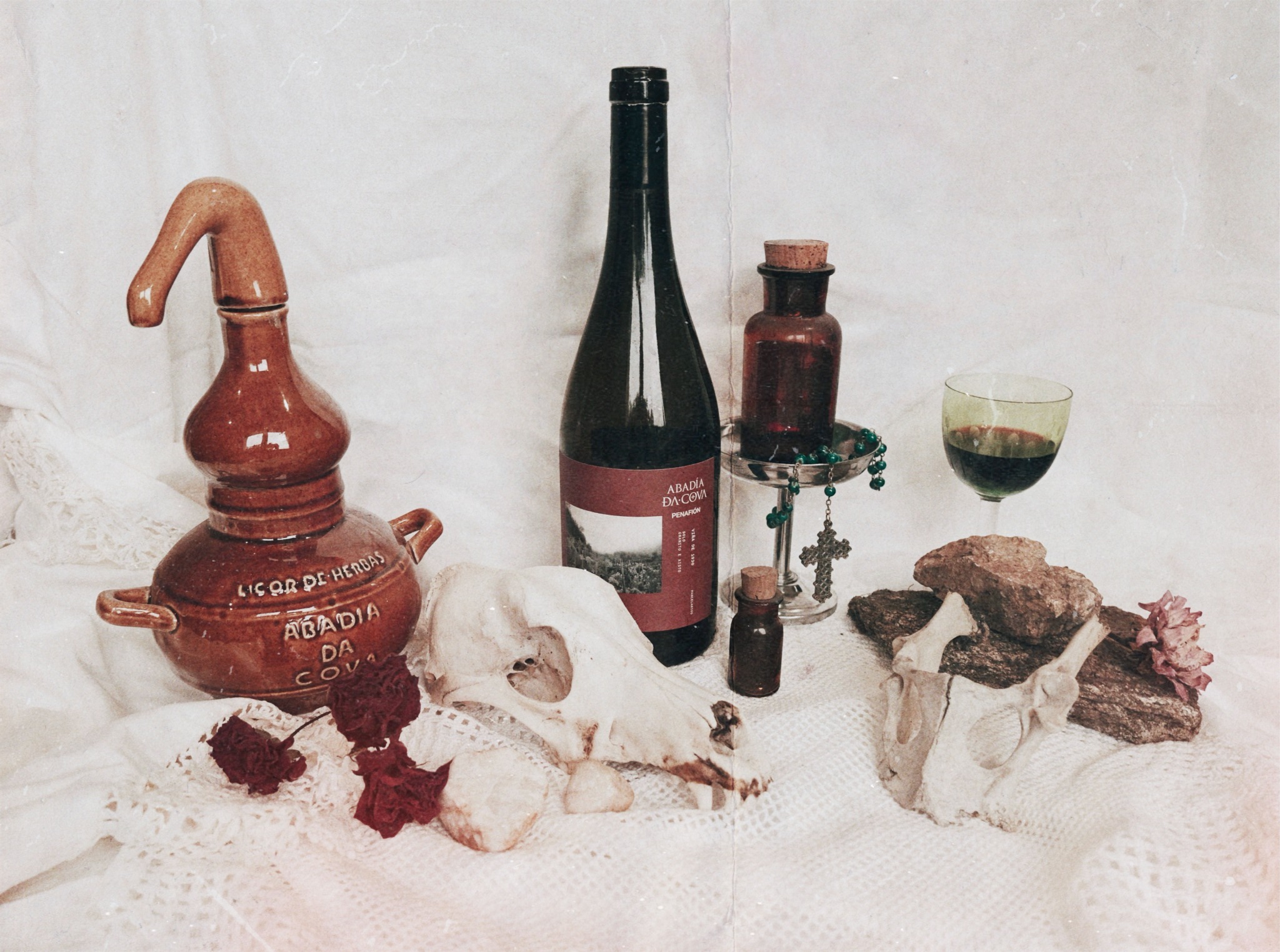
THE SACRALISATION OF A PAGAN RIVERBANK
Contrary to what many may think, the name Ribeira Sacra is relatively recent, as it appeared following the creation of the wine designation of origin.
In the mid-1990s, when its promoters were searching for an identity that would embrace its rivers, its riverbanks and its history, they found inspiration in a document found in the monastery of Santa María de Montederramo, dated 1124. The document mentioned the Rovoyra Sacrata, a term with significant evocative power and undoubtedly representative of this landscape, although without clear references that would allow it to be located at a precise point in the territory.
Furthermore, subsequent research indicated that the enigmatic Rovoyra Sacrata originated from Latin that had already been influenced by the Romance language of the time, and that its most plausible meaning referred to a ‘sacred oak grove’, perhaps a deep resonance of ancient cults or a lost spiritual geography. However, neither the uncertain spelling nor the divergent interpretations allow us to decipher with absolute certainty what that medieval writing really meant, so the truth, like so many others in these ancient lands, remains shrouded in mist, suspended between memory and myth.
That is our oldest sacred legacy. A legacy that passes down from generation to generation the message that the divine is revealed in the very matter of which the landscape is composed: in the hardness of granite, in the murmur of water, in the stillness of the mountains... In the idea that there is no distance between the human soul and the soul of the world. Thus began a form of spirituality that needed no intermediaries, a faith that saw in nature not only sustenance, but presence: the certainty that the world was alive and that divinity resided in it, silently.
Before monks built walls, rang bells throughout the valleys and filled the hillsides with terraces, there was already a silent worship of nature, a reverence for the mystery that beats in stone and water. Here, the roots of the sacred come from a time when the gods did not inhabit temples, but mountains, rivers, springs, caves and stars. And they did so for at least 4,500 years before the arrival of the Roman Empire and Christianity.
That brief medieval trace, just two words carried through time, served to give that name to a landscape that seemed to have been waiting for it forever.
It is an honour for our family to have been present at those beginnings in several ways. On the one hand, José Moure, founder of Adegas Moure in the 1950s, was one of the main sources Carlos Mouriño turned to in order to document the history of viticulture in the region and its situation in the 1980s, when Adegas Moure, before the creation of the D.O., was already a well-established company and a benchmark for other entrepreneurs. On the other hand, although José (Pepe de Cuñas, to all who knew him) was unable to see his dream come true of his land, his world and his work achieving the dignity he believed it deserved, his successors, Evaristo Rodríguez and José Manuel Moure, were among the voices who, at that moment, on the verge of making this D.O. official, were among the first to commit to the name by which the entire area has since become known.
This is how the Ribeira Sacra as we know it today came into being. However, this brief explanation falls far short of telling the true story of the spirituality of this land.
The stones rose up like words that the wind could not erase
At the end of the Neolithic period, the first megalithic monuments began to be erected in Galicia: dolmens, menhirs and alignments of vertical stones.
Dolmens are chambers formed by enormous slabs, conceived as thresholds between life and death where ancestors were evoked and honoured. From an archaeological point of view, dolmens vary in type (corridors, simple chambers, mounds of different sizes), reflecting chronological and functional diversity. In addition to serving as burial sites for the dead or for storing offerings, they probably acted as landmarks of belonging or delimitation of community spaces, marks that said ‘we live here,’ ‘we belong here.’ Recent archaeological studies have dated materials associated with some of these monuments and show a continuity and evolution of megalithic use over millennia in the region.
Alongside these tombs, menhirs and groups of standing stones also appeared. Their exact function remains a subject of research, but archaeological evidence and comparisons with other Atlantic territories suggest that they acted as symbolic markers of the territory and, in many cases, as places of worship related to the observation of the environment and the sky. Located on peaks, hills or natural entrances to valleys, they functioned as authentic stone beacons that helped to structure the physical and spiritual landscape of those communities.
Petroglyphs are another key testimony to the relationship between prehistoric communities and their territory. Their motifs (concentric circles, combinations of cup marks, animal figures, spirals, etc.) reveal a rich graphic tradition shared with other Atlantic regions, but with their own distinctive style. Engraved on outcrops visible from afar or alongside old roads, these designs probably served as signs of identity and ritual spaces and, in many cases, as markers in the landscape. Looking at them today is like peering into an ancient way of thinking that chose rock as a notebook for communicating with the world.
Finally, the hill forts (castros) appeared. Their walls, parapets and circular dwellings—built using the same patient technique required for granite—show how the rock was a functional support, a defence and a material for everyday life. But they were also spaces where architecture blended with the hillside, creating a symbiotic continuity with the environment reminiscent of earlier megaliths and petroglyphs. In each hill fort, stone once again becomes the line that connects the community with its landscape.
The invisible traces
The stones tell part of the story. The menhirs that rise towards the sky, the dolmens that guard the entrance to eternal night, and the iconography of the petroglyphs are the most solid traces of the ancient communities of the northwest. However, there is a second, less obvious archive that has also survived for millennia: words that name mountains and rivers, stories that were passed down without being written down, figures that continue to appear in the collective imagination as heirs to a distant past.
Among these figures are the mouras, almost always linked to places where the landscape retains a special density: springs with constant flow, isolated rocks, burial mounds overlooking a valley... Their stories coincide with those of other female beings in Atlantic Europe, guardians of ancient enclaves and symbols of continuity between the earth and those who inhabit it. Legends often suggest that they and the mouros were the architects of the stone monuments themselves, which could be an echo of their association with a primordial time.
The xacias, meanwhile, refer to another type of sacred space: water. Their hybrid nature embodies the mystery of dark rivers and deep lagoons, places that ancient communities considered points of contact with the invisible. Their figure combines functions of fertility, divination and danger, characteristics shared with other European water spirits.
When material evidence is combined with the intangible remains of folklore and place names, a coherent spiritual picture emerges: a world where nature was inhabited by protective or ambivalent beings, and where every spring, every hill and every stone could be a sanctuary. In this fabric, mouras, xacias and local deities survive, reminding us that the memory of early beliefs is not only engraved in stone, but also in words and in the landscape.
The translation of a pagan calendar of saints
The Roman invasion did not erase that ancestral voice, but merely translated it. The local gods adopted the names of their Latin equivalents, with the goddess Nabia becoming a nymph, Bandua becoming the god Mars, and Lug becoming Mercury. Roman temples were built on top of Galician shrines, and the very stones that had previously been venerated in themselves became Roman altars. Thus, a hybrid faith was born in which the ancient beliefs lived on under new guises, surviving the change of language, ritual and power.
After Christianity was authorised by Rome, the echo of the new faith slowly spread to the north-western reaches of the peninsula. In the Ribeira Sacra, this meant the arrival of the first anchorites, men and women who, driven by a desire for an ascetic and silent life, found an ideal space in this landscape: natural shelters, caves already laden with symbolic meaning, and mountains that, since pre-Roman times, had been centres of worship and places of spiritual transit.
However, Christianity did not arrive on virgin soil in these lands. The local population had deeply rooted forms of naturalistic and animistic spirituality dating back more than three thousand years, linked to rivers, sacred trees, springs and mountain peaks.
In this context, a decisive figure emerged: Prisciliano. His message emphasised asceticism, the study of the Scriptures and an intimate relationship with nature as a path to spiritual knowledge, as well as the consideration that women and men were equal in matters of religion, promoting, contrary to the official dictates of the Church, equal participation in ecclesiastical functions and liturgical celebrations. For this reason, his doctrine was warmly received by the Galician communities, who found in it a bridge between their ancestral beliefs and the new faith.
Although Priscillian was convicted and executed in 385 for heresy—becoming the first person sentenced to death for heresy by the Catholic Church—his influence endured for centuries, especially in rural and mountainous areas such as the Ribeira Sacra.
At the beginning of the 5th century, Rome was in decline, gradually losing territory throughout the Empire. In Hispania, what really mattered was maintaining control over the Mediterranean, so, faced with pressure from the barbarian peoples, it ended up ceding control of Gallaecia to the Suebi.
With their arrival, a clash of two spiritual worlds took place in Gallaecia. On the one hand, there was the deeply naturalistic Galician religiosity, which found the sacred in springs, mountains, trees and fire. On the other, the Arian faith of the Suebi, simpler than Roman Catholicism, closer to the idea of an orderly divinity and less dependent on images and urban rituals.
This initial contact does not appear to have been traumatic. The people continued to practise their rites, and the Suevi ruled without immediately imposing spiritual reform. However, in the mid-6th century, the figure of Saint Martin of Dumio marked an important change. With firm words but without violence, he tried to guide the people towards a coherent and disciplined Christianity. He pointed out many rural practices as superstitions like lighting ritual fires, hanging offerings on trees, or going to sacred mountains. His goal was to reorient Galician spirituality towards a Catholic and disciplined Christianity. The administrative division into parishes, which is still in force today, dates back to this period.
On the political front—which we will not explore in depth in this article—a historic event took place: the Suevo Kingdom of Galicia was proclaimed, the first medieval kingdom in Europe, as it was the first independent state to be established after the fall of the Western Roman Empire (411-585).
In short, the result of the changes implemented by San Martín's reform was not abolition, but transformation. Many rural customs continued, but were integrated into a Christian framework: springs were blessed, mountains were consecrated, and fire festivals were reinterpreted. Galician spirituality did not die: it underwent a metamorphosis.
This gradual process paved the way for the emergence of the first monastic communities. Monasteries offered a new way of relating to the sacred: silence, prayer, work, contemplation. And although their message came from Christianity, their location and essence were in dialogue with the ancient soul of the earth: remote places, surrounded by nature, where the spirit sought to rise as it had always done.
From this coexistence between the ancestral and the new, Galician-Christian spirituality was born, which would characterise Galicia for centuries.
A Sacred Path
In the 9th century, the discovery of skeletal remains near Compostela shook this remote corner of Europe. Although the Church attributed them to St James the Apostle from the outset and without any doubt, based on oral tradition, it does not seem so clear that this is the case. In fact, many experts today argue that it is not unreasonable to think that it is actually the heretic Priscillian who is still venerated in that tomb today. This is not unreasonable because it is known that, after his execution in Trier, his remains, together with those of some disciples, were brought back to the northwest, to the forests he walked and lived in, to the villages where he preached a pure faith, with no other goal than to live in peace and communion with nature. And it is not unreasonable that, given his proven importance and fame, his followers—many and very faithful— came for centuries from all corners of Gallaecia to worship him.
Is it possible that the Church invented the story of the stone boat containing the remains of the Apostle in order to supplant the true occupant of the tomb? We do not know, and for now science has been unable to confirm or deny either version, but it is curious, to say the least, to think that if the Way of St James was devised to cover up the cult of a heretic that had spread over the centuries, millions of people have been making pilgrimages for centuries from all corners of the Christian world to venerate the remains of a man who challenged the values of that Christianity.
Leaving aside this mystery, and hoping that it will one day be solved, the fact is that, with the expansion of the Camino de Santiago, the north-west opened up to the world. The Ribeira Sacra was directly affected by this, as many pilgrims chose a route that turned south from Astorga to enter a less harsh Galicia following the course of the Sil River, in order to avoid the snowy peaks of O Cebreiro in the colder months. This is how O Camiño de Inverno (The winter way) was born, a route that, in addition to avoiding the snowy passes, facilitated access to Galicia from the plateau and, with it, the flow of people and goods in inland Galicia and between the plateau and Santiago, the political, ecclesiastical and economic centre.
The monasteries of the Ribeira Sacra became part of the pilgrimage and hospitality networks: they welcomed travellers, guarded relics and spread knowledge. Accents, techniques and symbols from far away circulated through the Sil and Miño valleys. The flow of pilgrims brought openness without disruption. The roads passed through lands that had been sacred since ancient times, and those who stopped there found not only rest, but also a deep-rooted, palpable and genuine spirituality: prayers in Latin rose above ancient pagan altars and sacredness changed form, but not its essence.
Ora, labora et vinum mercare
Monasteries acted as religious, cultural and economic centres. With privileges and donations, they controlled land, organised vine cultivation and managed production margins that provided them with food, wine and income. Terraced viticulture (terracing or ‘socalcos’) is a key material trace: although there are indications that the presence of vines in the area dates back to Antiquity (even to Roman times), the massive structuring of the landscape into terraces was consolidated in the Middle Ages with the recovery and intensification of cultivation by religious and peasant communities.
In the construction of the terraces, as had been the case with the hill forts, stones, both converted into ashlars and integrated into the structures in their natural form in the heart of nature, played and continue to play a leading role. And not only in the constructions themselves: their ability to store heat from the sun makes them natural heaters that influence, above all, in the ripening process of the grapes.
However, this professionalisation and accumulation of wealth by some monasteries contrasted with the original experience of the hermit: the anchorite sought renunciation and poverty, while the monastic institution that emerged here ended up managing land, collecting rents and participating in an almost business-like logic. Over time, coexistence between peasants and monks became complex: farmers depended on the land and, in many cases, on seigneurial or ecclesiastical monopolies, their faith being conditioned by labour obligations and taxes.
But, for the peasants of the Ribeira Sacra, religiosity was not just doctrine: it was daily practice and a collective bond. The pilgrimages, still so present throughout Galicia, are the best example of this. They were social events that attracted large numbers of peasants from the region and even from neighbouring regions. They made pilgrimages to cruceiros located on mountain tops, to churches with miraculous springs, to dense forests where shrines seemed to blend into the landscape, to temples at the foot of rock formations... There, open-air masses were celebrated (and in some cases still are), along with processions with the corresponding image, communal meals, music and the exchange of favours and promises.
The renaissance of silence
But, as is often the case, splendour was followed by decline. The Way of St James gradually lost importance and, as a result, generated fewer profits; successive ecclesiastical reforms undermined the power of the congregations in the area and, to top it all off, the arrival in power of the Catholic Monarchs and their centralising and imperialist policies plunged Galicia into a depression that lasted for centuries.
It led to the closure of many important monasteries and the decline of many others. However, for the peasantry, it did not have such far-reaching consequences. It is true that the notable decline in the monks' economic activity reduced the amount of land under cultivation and, therefore, the need for labour, but most people remained just as poor. So they did not actively change their way of earning a living or their way of practising their religion.
The Modern Age passed without major changes for them. Over the centuries, the monasteries lost their splendour, some of them ending up in ruins. However, many of the churches in these complexes remained standing, and generation after generation, the inhabitants of this land continued to visit them to celebrate the same things they had been celebrating in those same places since ancient times. The same pilgrimages, the same legends of mouras and xacias, the same miraculous springs... Because what makes this riverbank sacred is not the churches, but the persistence of the bond between the people and the land.
The New Awakening
Today, the Ribeira Sacra continues to be a place capable of preserving memory and engendering the future. The landscape continues to speak the same ancient language and its spirituality, although changed in form and language, has not died out. It persists in the way its inhabitants relate to their environment, in their respect for the rhythm of the earth, in the gaze that recognises the divine in everyday life, and also in the emotion of those who come from outside and, without really knowing why, feel that this landscape contemplates them.
Perhaps that is what still makes it sacred: its ability to awaken, even in the most fleeting visitor, the memory of a faith that needs no name. Those who look at it closely understand that what endures here is not just a landscape, but a way of being in the world.
Because this river became sacred without ceasing to be human. And perhaps that is where, in the end, the true sacralisation of a pagan riverbank.
Documentation and writing: Lorena González Blanco
Image selection and editing: Paloma R. Moure
Photographic collection: Gustav and Marisa Rey-Henningsen (Provided by the Museo do Pobo Galego)

1 Comment
Francisco Pelayo · 11 December, 2025 - 00:12
Un perfecto y detallado relato para entender la historia de la Ribeira sacra con matices tan acertados como que esa denominación no se debe a la proliferación de Iglesias y desaparecidos Monasterios sino por el vínculo de las Personas y la Tierra o que esta Ribeira se hizo Sagrada sin dejar de ser Humana.


